

SftDate_SetCulture defines the culture of a control: its date and time patterns, the names of months and days, the AM/PM designators, the first day of the week, the week number rule, the century used for two-digit years and the calendar system. The culture is a locale name, such as "de-DE" or "ja-JP", and a Windows calendar identifier (CALID). Without a culture, or with a NULL locale name, the control uses the user's default locale, including the changes the user made to its formats in the Windows region settings. Each control has its own culture, independent of the system settings, and the dropdown calendar of a field uses the field's culture.
SftDate_SetCulture(hwndField, TEXT("de-DE"), 0);       /* German, Gregorian calendar */
SftDate_SetCulture(hwndCalendar, NULL, 0);             /* the user's default locale */
SftDate_SetCulture returns FALSE if Windows does not know the locale or the locale does not offer the calendar. SftDate_GetCulture returns the locale name and the calendar identifier that were set.
With a calendar identifier of 0, the control uses the locale's default calendar. Many locales offer other calendars as well; SftDate_GetOptionalCalendars returns the calendar identifiers a locale offers, so an application can let the user choose one:
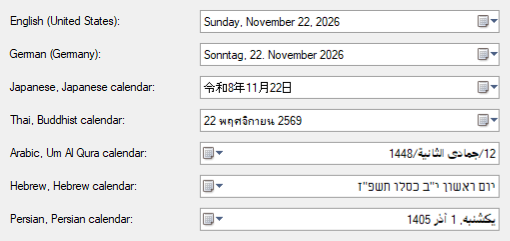
SftDate_SetCulture(hwndField, TEXT("ja-JP"), CAL_JAPAN);   /* Japanese calendar with eras */
SftDate_SetCulture(hwndField, TEXT("ar-SA"), 0);           /* the locale's default, Um Al Qura */
SftDate_SetCulture(hwndField, TEXT("he-IL"), CAL_HEBREW);  /* Hebrew calendar */
The calendar systems are Gregorian (CAL_GREGORIAN and its localized variants such as CAL_GREGORIAN_US and CAL_GREGORIAN_ARABIC), Japanese (CAL_JAPAN, with the eras Windows defines), Taiwan (CAL_TAIWAN), Korean (CAL_KOREA), Thai Buddhist (CAL_THAI), Hijri (CAL_HIJRI), Um Al Qura (CAL_UMALQURA), Hebrew (CAL_HEBREW) and Persian (CAL_PERSIAN).
The fields edit and the calendars show the years, months and days of the calendar system, including its eras, its leap months and, in the Hebrew calendar, Hebrew numerals. The values the functions and notifications exchange are always SYSTEMTIME structures of the Gregorian calendar, so the application's data does not depend on the culture.
| Calendar | Example |
|---|---|
| Gregorian |  |
| Japanese (with eras) |  |
| Hebrew |  |
| Hijri (Um Al Qura) |  |
Calendars with several eras, such as the Japanese calendar, offer the month and year views only (see Calendar Layout and Views).
The culture does not change the layout of a control. For right-to-left languages such as Arabic, Hebrew and Persian, the application turns on the right-to-left layout with SftDate_SetRightToLeft (see Right-To-Left Reading Support).
The texts the controls show themselves, the texts of the Today and Clear buttons (SftDate_SetTodayText, SftDate_SetCalendarClearText), the range separator (SftDate_SetRangeSeparator) and the placeholder of an empty field (SftDate_SetPlaceholderText), are defined by the application in the language of its users.

 On
 Off